

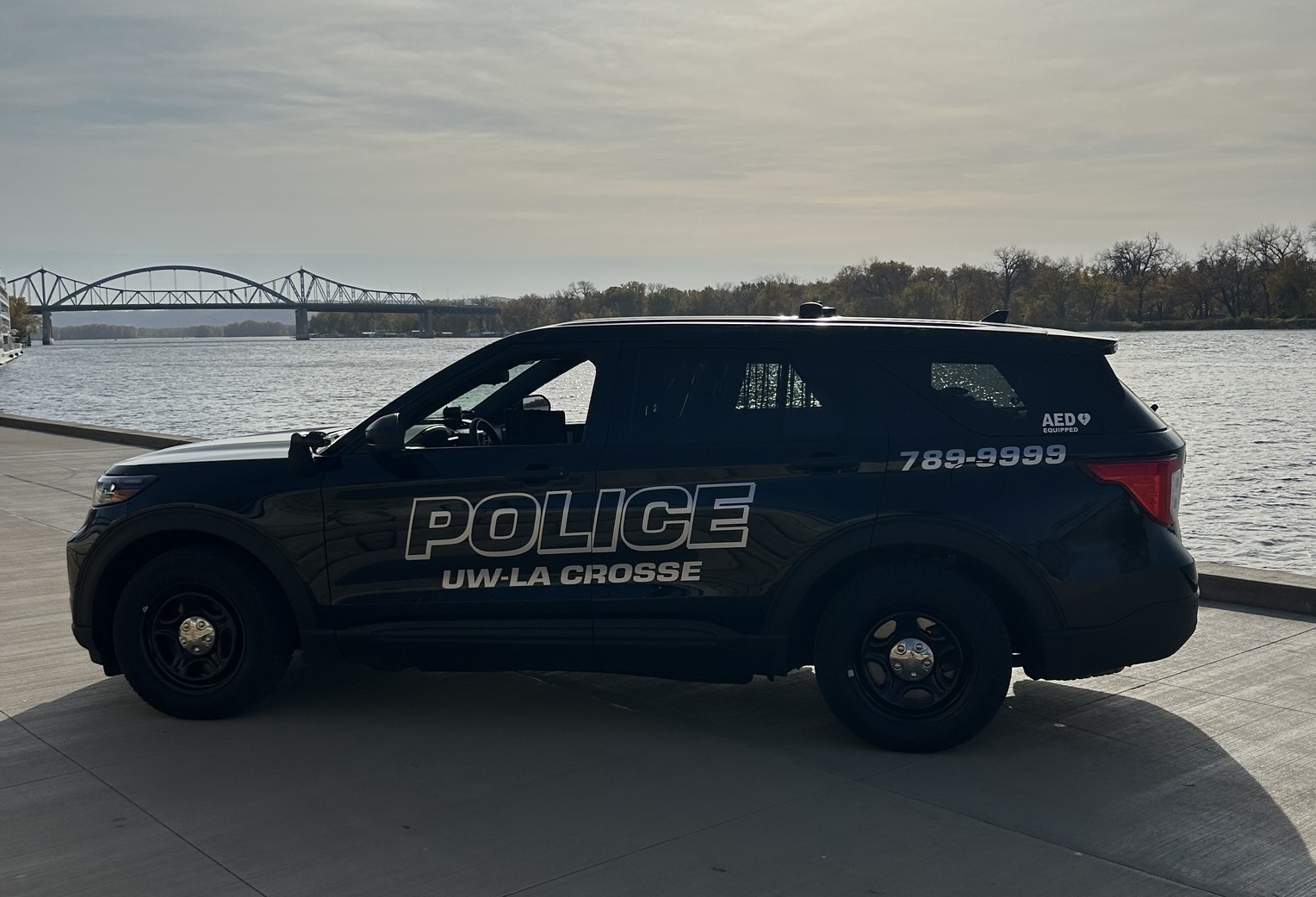
The police department was knocked for “shoddy record keeping” and a “lack of leadership” in a 2019 investigation. A police chief hired the same year says he’s made major changes to revamp the organization.
By Annie Pulley, THE BADGER PROJECT
“The pervasive, caustic atmosphere of the UWL PD is evident after speaking with most members of the department.”
That’s how a criminal investigation described the UW-La Crosse Police Department in 2019. More than six years and one police chief later, the department says it has drastically improved.

“We now operate with clearly defined expectations, documented processes, and consistent oversight, leaving little room for ambiguity or for unhealthy practices to take root,” said Chief Allen Hill.
The university hired Hill in 2019, the same year the investigation was unfolding. Hill told The Badger Project last month he understood the department was experiencing internal issues when he started. He had been working in Texas and was not fully aware of the depth of the problem, he said.
“I knew there was some work to be done,” Hill said.
Hill — an Army veteran who has more than 20 years of law enforcement experience and previously led a university department in Houston — told The Badger Project his staff responds to about 900 calls a year. The top incident types are for alcohol or drugs, theft, property damage and vandalism.
Since Hill was hired, 20 officers have resigned. His department is budgeted for 14 police officers and currently has 12 on staff, he said.
Over his tenure, he said he’s steered the department through a three-year accreditation process; overhauled the department’s command structure; implemented a new training system; and has worked to build a culture based on unity and initiative.
Consider a donation to help us shine a light on the powerful in Wisconsin.
DONATEThe 2019 criminal investigation began shortly after two UW-La Crosse police officers brought allegations of misconduct to the Wisconsin Department of Justice and the university’s vice chancellor. The officers accused the then-newly retired police chief and a handful of other members of falsifying and inflating department training records.
The university tapped the UW-Madison Police Department to lead the investigation, which eventually concluded that no criminal violations occurred. It instead ruled that the university’s department was plagued by “shoddy record keeping,” “disorganization,” a “lack of leadership and structure” and internal division.
“Many of these issues could have been avoided had there been a leadership presence that supported progressive discipline and holding people accountable for their actions,” an executive summary from UW-Madison’s 556-page investigation report reads.
The division and mistrust within the department spurred Officer Dustin Barton and Sgt. Jordan Schaller to conduct their own investigation and bring allegations to university officials, according to a summary of the UW-Madison Police Department’s investigation. But ultimately, the officer’s unofficial probe was unapproved and deemed concerning by the UW-Madison Police Department.
Barton and Schaller no longer work for the UW-La Crosse Police Department. Barton resigned in 2023 prior to the conclusion of internal investigation, according to a state Department of Justice database that tracks negative separations from law enforcement.
The investigation from the UW-Madison Police Department detailed how the training records members entered into the statewide portal were often inaccurate; that there were no central training files kept in the department; and no department procedure on how to accurately complete a timesheet. It went on, describing how members felt the department culture was “permissive” and that former-Chief Scott McCullough made promotional picks based on favoritism and didn’t adequately respond to staff concerns.
Progress since 2019
Before he arrived, Hill said he sent out evaluations to every member of the department to describe the strengths, weaknesses, opportunities and threats each observed. Among his first priorities was to collectively develop a mission and vision statement for the university department.
“Everybody had input,” Hill said.
Department training, which had been primarily outsourced to other agencies, is now done primarily in house and overseen by a training sergeant and committee, the chief said. At least twice a year, the entire department trains for a full day together. New members also have a chance to leave reviews of their field training officers.
He also turned his attention to the leadership structure.
“There was no established command staff,” he said.

He brought on a third sergeant and made unity of command a priority. Leadership may internally disagree but that disagreement doesn’t spread outside the command circle. He said it has helped address the divisions that were once prominent within the department.
Hill also led the department through an intensive, voluntary accreditation process over three years. The process required the department to review and shape its existing policies to align with state standards and the department’s unique goals. A team of independent assessors also did an on-site evaluation of the department as part of the process.
Officers routinely take advantage of his open-door policy and come to him with thoughtful proposals, he said, ranging from ideas for new holsters or vests to how the university community could benefit from a K9 support dog.
As the department looks toward 2026, its next steps include succession planning, developing staff wellness and drone programs and identifying additional security needs throughout campus, he added.
“The department’s culture today is one where professionalism, fairness, and mutual respect are the norm, and any behaviors that undermine those values are quickly addressed rather than allowed to persist,” Hill wrote in an email to The Badger Project.
This story was funded in part by a grant from the La Crosse Area Community Foundation.
The Badger Project is a reader-supported, independent news nonprofit in Wisconsin.
SUPPORT OUR WORK AND HELP US INVESTIGATE THE POWERFUL!
DONATE

Leave a Reply