

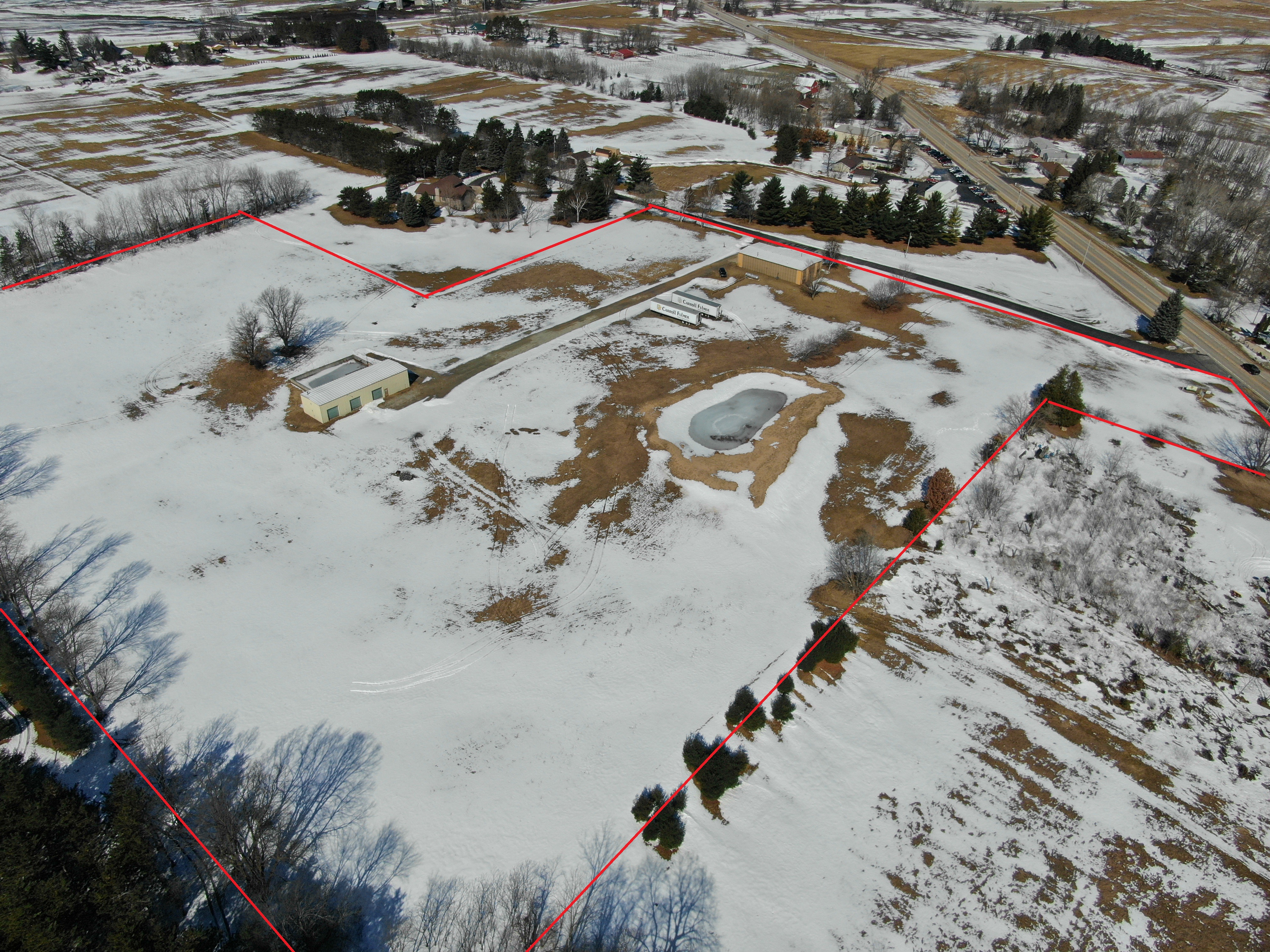
A man in a small town in Outagamie County says his neighbors, who sit on the town board, have been unfairly blocking his attempts to expand his business for years. They say it’s a zoning issue.
By Annie Pulley, THE BADGER PROJECT
“I have reasonable suspicion that my business has been unfairly targeted and legislated against for the last six years.”
That’s according to a letter Ryan Richeson sent to news outlets last September.
Richeson, 40, owns a landscaping business in the Town of Hortonia, a rural community nestled in Outagamie County and home to about 1,000 people.
Before he purchased the property for his business in 2019, town bureaucrats assured him they would accommodate him even as half of his parcel was zoned for residential use only. But the town changed its tune a couple years after he bought his property. Richeson believes the opposition to his business and his plans to expand it is tied to the fact that many of his neighbors are on or closely connected to the town board. Court rulings have so far not gone in his favor.
Now, seven years after he bought the property, Richeson faces between $200,000 and $600,000 in retroactive fines for violating town zoning ordinances. He is also facing about $100,000 in legal fees from suing the town and being sued by it, he told The Badger Project.
The town says Richeson has been unlawfully operating his business on property zoned for residential use, according to its lawsuit. Rezoning Richeson’s property, the town argues, would violate its comprehensive plan while Richeson’s intentions to expand his business would have “unacceptable impacts on neighboring properties.”

Both the Outagamie County and state appellate court sided with the town in Richeson’s first lawsuit. The town’s own lawsuit against him, which is still pending, says Richeson must pay between $200 and $500 a day for violating town zoning ordinances. The daily fines began accumulating in December 2022.
“If the court case does go the wrong way,” Richeson said about the town’s lawsuit, “it’s literally going to bankrupt me and ruin my family.”
In its lawsuit, the town argues it chose to reject Richeson’s business expansion “over the course of three separate meetings before a final decision was issued, and in the process, it compiled a record of approximately 450 pages,” the lawsuit reads. “These are not the actions of a municipality that is acting arbitrarily, oppressively, or unreasonably. They are the actions of a municipality doing its job thoroughly.”
The legal fight is set in stark contrast to Richeson’s initial conversations with the town about his property. The town clerk and zoning administrator were originally willing to help Richeson with an application to rezone his property, according to numerous emails Richeson shared with The Badger Project.
“I advised Mr. Richeson to complete and submit an application for zoning change for the (residential) portion of the property,” town zoning administrator Jeffrey Sanders wrote in a 2019 email. “It is my recommendation that the town waive the application fee since the multiple zoning classifications should never have been permitted.”
With their assurances, Richeson decided to buy the property in 2019.
“They had told me that it would be able to be fixed,” Richeson told The Badger Project. “I reached out before I even bought the property just to make sure we were good.”
Consider a donation to help us shine a light on the powerful in Wisconsin.
DONATE“This was a property that fell through the cracks with a group of properties rezoned quite a while ago but not recorded,” wrote town clerk Lyn Neuenfeldt in a September 2021 email. “I am working with the county to resolve this.”
Richeson believes the town did rezone his property shortly after he purchased it but then “messed something up” and the rezone was never recognized.
In 2020, even as his parcel was still zoned partly residential and partly commercial, Richeson went back to the town with plans to apply for a permit to expand his business. He wanted to establish a “commercial incubator” on his property and rent space to dozens of other businesses.
In a February 2020 email, Sanders again said Richeson’s property should be either zoned entirely commercial or entirely residential. Sanders said the town should defer to the landowner.
Richeson then spent $30,000 to develop a site plan he could submit to the town for his business expansion. The town clerk wrote in a September 2021 email that the site plan was approved contingent on Richeson addressing a couple of concerns.
But then in 2021 it all came to a “screeching halt,” Richeson said. He believes it’s because his neighbors got involved.
Richeson’s neighbors — Dennis Clegg and his sister, Nancy Willenkamp — both sit on the three-person town board. Clegg was reelected to the town board as chair in 2020. James Bolssen, who lives west of Richeson and shares a driveway with him, has known Clegg for decades, according to testimony from when Clegg was deposed. James Bolssen’s son, Kevin Bolssen, also has property in the area and was formerly the town chair.
Clegg said in his deposition that James Bolssen spoke with him about his concerns with Richeson’s business operations.
“Well, he’s concerned about that driveway,” Clegg said about James Bolssen in the deposition. “They come screaming up the driveway as loud as they can with the trucks he said, turn into the gravel, spin all over the place. You know, then it wakes him up at 6:00 in the morning, and he’s just fed up with it, you know?”

Each time Richeson tried to get his rezoning and permit applications before the planning commission and town board, the meeting date was rescheduled, he said. The town still held its regular meetings, but Richeson’s property didn’t make it on the agenda, he said. In October 2021, the town cancelled a public meeting to discuss Richeson’s zoning applications.
Richeson’s case finally went before the planning commission in April 2022, two years after he first reached out to the town in hopes of expanding his business. Members of the public who spoke at the meeting voiced opposition to Richeson’s plans, according to the town’s lawsuit. Complaints included noise, traffic and property value concerns.
Richeson told The Badger Project that Clegg, who raised concerns about how Richeson’s business expansion would stress emergency services and compromise the rural aesthetic of the town, had tried to sell a 40-acre property in town, marketing it as prime real estate for a significant housing subdivision.
“This was the point that I started realizing that they just want this property empty or not used at all,” Richeson said about his land. “And I didn’t know why.”

When reached by The Badger Project, Clegg said he was advised by the town attorney not to speak about the case. Town attorney Matthew Parmentier did not respond to repeated requests for comment.
Sanders, who in 2019 said having dual-zoned lots was not in the interest of the town, drafted a report for the plan commission that said Richeson’s plans could either be consistent or inconsistent with the town’s comprehensive plan. When asked to submit a second report, Sanders said in May 2022 that Richeson’s plans were inconsistent.
The plan commission and town board unanimously voted to reject Richeson’s plans the same month, and Richeson took the town to court. The town countersued, arguing that it was not obligated to fulfill the promises made by the town clerk and zoning administrator.
“Binding municipalities to every representation made by subordinate employees would produce severe results for the municipalities,” the town argued in its legal brief. Richeson’s company “proceeded at its own risk.”
An appeals court sided with the town last September, writing that the court is meant to presume the town’s decision is valid.
“The town’s zoning administrator’s belief that the dual zoning is ‘problematic’ does not mean that it violates the regulations,” the court decision reads.
If the courts again favor the town, Richeson could be liable for massive retroactive fees for operating his business.
The town has since offered to buy Richeson out in exchange for dropping its lawsuit and any associated fines. Richeson said the town offered him $250,000 for his property, which he says is now worth $1 million. When he asked that their offer reflect its market value, the town declined.
The Badger Project is an independent, reader-supported news nonprofit in Wisconsin.
FREE TO READ. EXPENSIVE TO PRODUCE.
Creating our hard-hitting news takes a lot of time and money.
A story like this needs at least 8 hours to research, write and edit.
Please consider financially supporting The Badger Project to help us do more reporting in the future.

Leave a Reply