

Personal wealth isn’t required to run for higher office, but it certainly helps. Three candidates in northwestern Wisconsin have tried to jumpstart their campaigns with massive payments from their own bank accounts, mirroring a national trend.
By Annie Pulley, THE BADGER PROJECT
Political candidates in the state’s northwoods are spending huge amounts of their own cash to try to win the open U.S. House seat there.
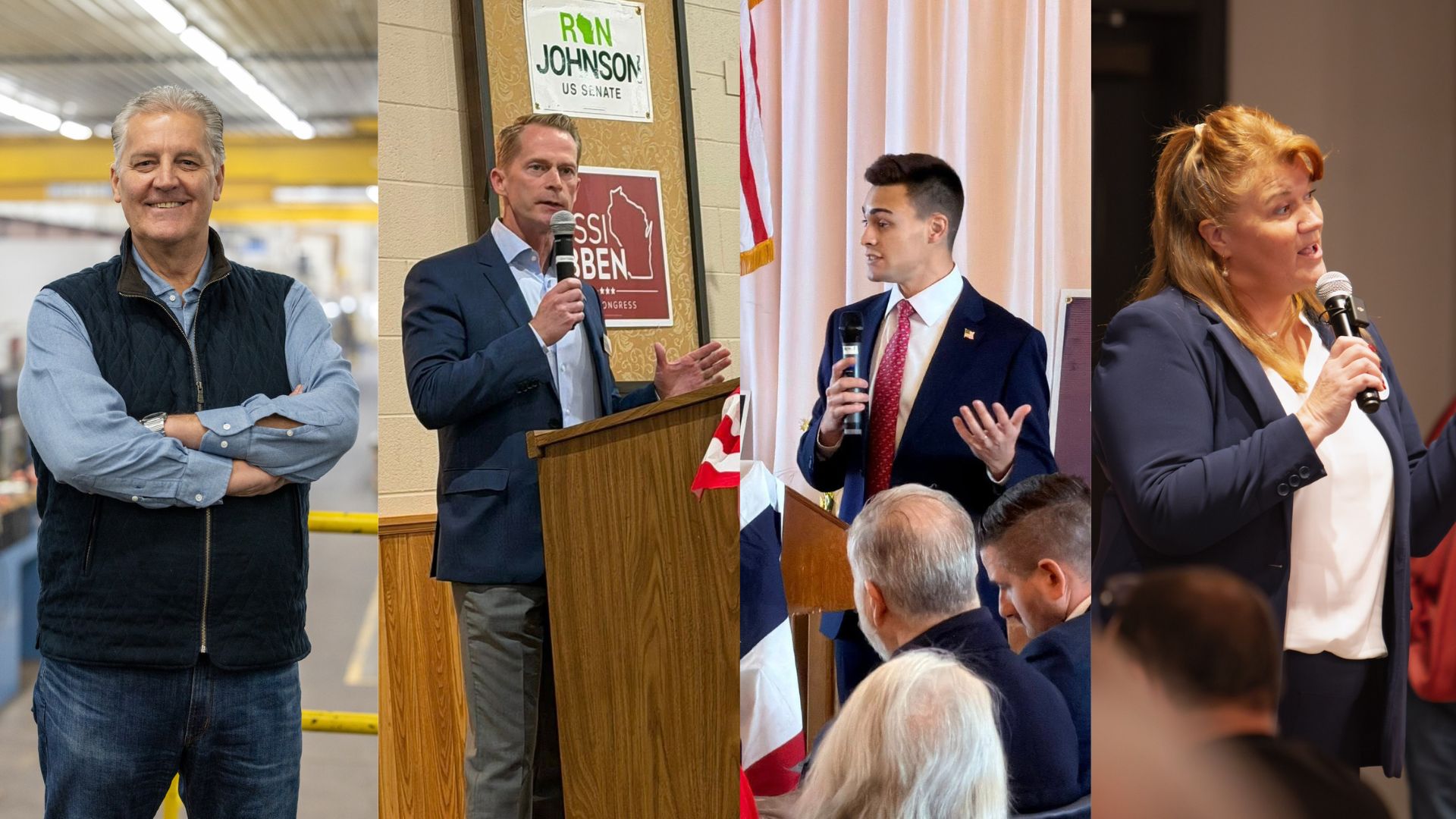
Wausau financial advisor Kevin Hermening, vying for a shot to be the Republican pick, has given his campaign just over $1 million, according to mandatory filings with the Federal Elections Commission. Before Ashland attorney Paul Wassgren, also a Republican, quit the race, he donated a whopping $3.2 million to his campaign. Northwoods family law attorney Ginger Murray, running in the district’s Democratic primary, loaned her campaign $100,000.
And a super PAC supporting 26-year-old candidate Michael Alfonso got a $1 million donation from the campaign committee of his father-in-law, Sean Duffy, who is a member of President Donald Trump’s cabinet and was the congressman for the same district from 2011 to 2019.
The salary for a member of Congress – both the House and Senate – is $174,000. It has remained unchanged since 2009.
Together, Hermening, Wassgren and Murray have put more than $4 million into their own campaigns. The total amount raised by the three candidates from outside donors, however, sits at about $215,000. Wassgren, now that he is no longer in the race, has reimbursed himself at least $1.2 million, according to FEC filings. He reported spending nearly $1.7 million.

The number of federal candidates across the country contributing large sums to their own campaigns is about the same as it was in 2024, according to OpenSecrets, a government watchdog in D.C. that follows money in politics. But in the long term, a trend has emerged, said Brendan Glavin, the director of insights for OpenSecrets.
In 2016, 23 candidates gave their campaigns at least $1 million. In 2024, 65 candidates did, according to data from OpenSecrets.
Glavin estimated that about a third of candidates running in races without an incumbent in 2026 are contributing at least $100,000 to their own campaigns.
“Is it worse if it’s your own money or if it’s money you’ve raised? Is it worse if you’ve raised money from out-of-state, big-time donors who give you the maximum contribution? Or is it better to have contributions of $5 and $10?” asked Brandon Scholz, an independent political analyst who runs The Capitol Group, a Madison-based public affairs and lobbying firm. “It doesn’t really matter. You raise whatever you need to raise, however you need to raise it, to be able to win if you’re serious about representing people in whatever office.”
Consider a donation to help us shine a light on the powerful in Wisconsin.
DONATEYou don’t have to be rich to run for Congress, but if you don’t have political connections or an established donor base, wealth is an important tool to get started, said Glavin.
In 2022, the U.S. Supreme Court made it a little more enticing for candidates with deep pockets to donate to their own campaigns. A 6-3 decision split down ideological lines between the conservative majority and the liberal minority and sided with Sen. Ted Cruz (R-Texas), who argued that a law capping how much a campaign can reimburse a candidate for federal office with donations made after the election was unconstitutional. The Bipartisan Campaign Finance Reform Act limited the reimbursement amount to $250,000. The court wiped it out, effectively removing that cap.
Donating to a campaign after the candidate wins is becoming more common, an OpenSecrets blog post reported in 2022. This way, donors who didn’t support the winning candidate before the election can get in his or her good graces, via federally regulated post-election contributions and potentially buy favor, Open Secrets argued. And it gives wealthy candidates more opportunities to recoup the money they invested in their own campaign.
“For someone who’s considering running and putting their own money into the race,” Glavin said, “that change has to factor into their decision.”
Congressional races themselves keep getting more expensive, and experts project the 2026 midterms to break spending records again. In 1998, the inflation-adjusted amount spent on every congressional race was about $3 billion, according to OpenSecrets data. In 2024, it was closer to $10 billion.

From ad buys to travel expenses, modern campaigns are more sophisticated and more expensive than ever, Scholz said.
“It’s ugly. It’s hard. It’s no fun. People don’t like to raise money. But, if you want to win, here’s what it’s going to cost you,” Scholz said. “You have an obligation as a candidate to do every damn thing, as long as it’s legal, to turn those people out to vote.”
Unless a constitutional amendment or court decision restricts the money super PACs, organizations that can raise and spend unlimited amounts, can pump into elections, Glavin said, it isn’t likely that the money spent on elections will decrease going forward.
A November 2024 ballot initiative in Maine almost succeeded in limiting super PAC contributions to $5,000. The initiative, which 75% of the state’s voters approved of, faced immediate challenges and a district court ruled against it. The case may end up in the U.S. Supreme Court.
But even without the super PAC, political candidates are “gonna find some other way to do it,” Glavin said. “The money seems to always find its way in.”
You can’t turn off the spigot, but a little sunlight, including from journalists, goes a long way, Scholz said. Sometimes you send a donation check back, he noted, recalling when the campaigns he worked for received donations from less-than-palatable groups.
“The more light you shed on contributions and who they came from, when they came from, where they came from and what they were all about, that will impact these races,” Scholz said. “It may make a candidate think twice.”
The Badger Project is an independent, reader-supported news nonprofit in Wisconsin.
FREE TO READ. EXPENSIVE TO PRODUCE.
Creating our hard-hitting news takes a lot of time and money.
A story like this needs at least 8 hours to research, write and edit.
Please consider financially supporting The Badger Project to help us do more reporting in the future.



Leave a Reply