

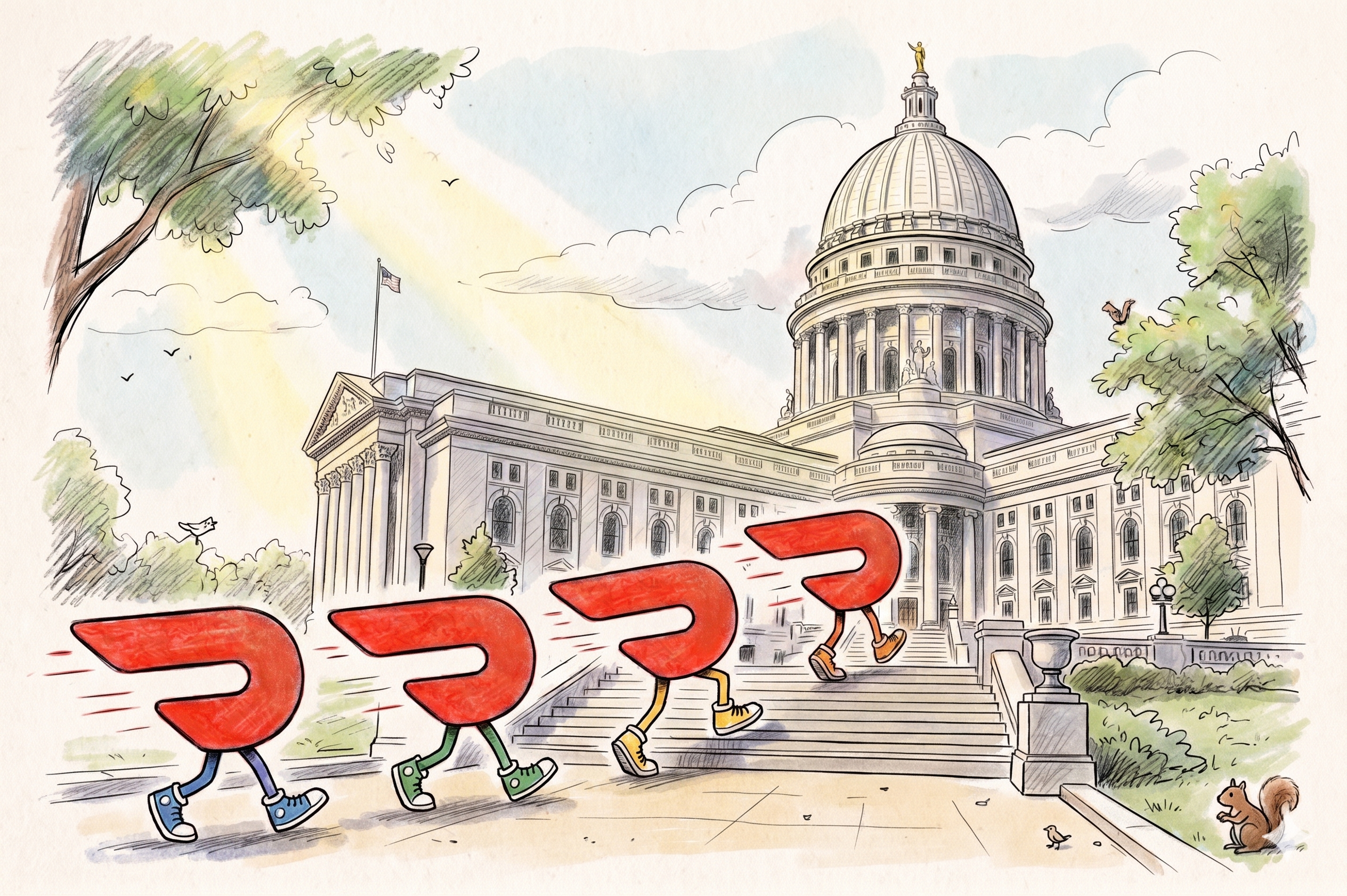
The delivery app company from California spent more than double that of any other organization in Wisconsin lobbying in 2025, as it pressed lawmakers to pass the bill. But Gov. Evers vetoed it.
By Peter Cameron, THE BADGER PROJECT
The delivery app company DoorDash reported spending nearly $2 million in the first half of 2025 lobbying the Wisconsin State Legislature, according to mandatory filings with the state, to pass a bill that would ban drivers from being classified as employees, blocking their ability to receive the corresponding benefits.
That’s more than twice as much as the next highest spending lobbying organization, Wisconsin Infrastructure Investment Now, Inc., a Madison-based organization that advocates for the construction, utility, telecommunications, and mining industries. It reported spending nearly $900,000 lobbying in the first half of 2025, and a little more than $1 milllion total for the year.
DoorDash also reported more lobbying spending than any organization in Wisconsin in the whole year of 2025, at nearly $2.2 million.
“That sounds like an absurd amount,” said state Rep. Mike Bare (D-Verona), a former lobbyist who voted against the driver bill.
And it’s unclear what DoorDash, a publicly traded company, spent all that money doing, because its mandatory report to the state is vague, the company refused to clarify when asked multiple times, and the Wisconsin Ethics Commission, which oversees lobbying, cannot investigate without a formal complaint.
SUPPORT OUR WORK AND HELP US INVESTIGATE THE POWERFUL!
DONATEThe company’s full-court press appears to have worked, as Republicans in the majority in both houses of the Legislature brought the proposed legislation to a vote, no easy task amongst the plethora of bills being pushed at all times, and then passed it, mostly along partisan lines. But Gov. Tony Evers, a Democrat, blocked it with his veto in August 2025.
The bill would have more clearly defined the difference between an employee and an independent contractor, and established that drivers for app-based services like DoorDash and Uber are not employees of those companies, eligible to receive benefits like workers’ compensation insurance, minimum wage, and unemployment insurance.

The proposed legislation allows companies like DoorDash and Uber to create and contribute to “portable benefits” accounts for drivers, defined under the bill as independent contractors, to use for things like retirement accounts and medical expenses, though their creation would not be mandatory.
DoorDash argues that the bill allows drivers to maintain their flexibility in deciding when and where they work as independent contractors, while still receiving some job benefits.
“While we couldn’t get the Legislature and the Governor to reach an agreement, we were proud to support a policy that is extremely popular with our Dashers (drivers) and has proven to be successful in states where portable benefits were made available,” said DoorDash spokesman Tyler St. Clair in an email to The Badger Project.
The parent company of the food delivery app Instacart, Maplebear, and the ridesharing company Uber also pushed legislators to pass the bill, reporting spending $140,000 and $80,000, respectively, lobbying in Madison in 2025. Other groups supporting the legislation include the Koch Network’s pro-business political organization Americans for Prosperity, the Greater Madison Chamber of Commerce, Wisconsin Manufacturers and Commerce and the Wisconsin Restaurant Association.
The labor union Wisconsin State AFL-CIO was the only organization to report lobbying against the bill.
“It’s a cannon vs. a popgun,” said Mordecai Lee, a UW-Milwaukee political science professor emeritus in an email, noting the difference in funding and resources in the fight to pass the legislation.
But those opposing the bill did hold a major weapon: the governor’s veto pen. Evers said he nixed the bill in its entirety because he objected to its definition of independent contractor status in the absence of guaranteed benefits for workers in the state.
“App-based drivers are a growing segment of Wisconsin’s workforce and changes to independent contractor definitions are a serious endeavor – one that demands substantive conversations among several parties, including with both management and workers, in order to achieve an appropriate and balanced policy that all sides can support,” Evers wrote in his veto message.
His requests for dialogue on this issue were declined by the Republican majority, he said in the message.
Top lobbying spenders in Wisconsin in 2025
| January-June | July-December | Whole year | ||
| DoorDash, Inc. | ||||
| Hours: | 171 | 79 | 250 | |
| Dollars: | $1,934,224 | $249,400 | $2,183,623 | |
| Wisconsin Infrastructure Investment Now, Inc. | ||||
| Hours: | 0 | 0 | 0 | |
| Dollars: | $868,054 | $138,889 | $1,006,943 | |
| Wisconsin Manufacturers & Commerce | ||||
| Hours: | 2,515 | 2,325 | 4,840 | |
| Dollars: | $496,501 | $415,092 | $911,593 | |
| Wisconsin Hospital Association | ||||
| Hours: | 2,082 | 1,290 | 3,372 | |
| Dollars: | $533,892 | $284,739 | $818,631 | |
| Wisconsin REALTORS Association | ||||
| Hours: | 2,293 | 2,141 | 4,434 | |
| Dollars: | $426,668 | $381,250 | $807,918 | |
| Wisconsin Farm Bureau Federation | ||||
| Hours: | 1,604 | 1,224 | 2,827 | |
| Dollars: | $300,075 | $308,171 | $608,246 | |
| Americans For Prosperity | ||||
| Hours: | 465 | 401 | 866 | |
| Dollars: | $117,711 | $490,323 | $608,034 | |
| Wisconsin Property Taxpayers Inc | ||||
| Hours: | 2,967 | 3,056 | 6,023 | |
| Dollars: | $252,619 | $255,613 | $508,232 | |
| Wisconsin Insurance Alliance | ||||
| Hours: | 465 | 391 | 856 | |
| Dollars: | $285,938 | $205,177 | $491,115 | |
| Wisconsin Counties Association | ||||
| Hours: | 1,433 | 981 | 2,414 | |
| Dollars: | $252,242 | $188,828 | $441,070 | |
‘Not even a cup of coffee’
While the idea of lobbying may conjure the image of a suitcase full of cash handed over to a politician in exchange for a vote, that is illegal in Wisconsin.
In fact, the state has very strict laws regarding the issue. Lobbyists here are not allowed to give anything of monetary value to politicians and government officials, “not even a cup of coffee,” as the expression goes. So the bulk of the reported spending is often paying the salaries of the lobbyists, or hiring contract lobbyists, experts say.
DoorDash reported having a team of five lobbyists, which includes former state Rep. Mike Kuglitsch, a Republican from Waukesha County who served in the Legislature from 2011-2022 and now works for the national government relations firm Michael Best Strategies.
But DoorDash reported only about $40,000 in payments to its lobbyists in 2025, leaving nearly $1.9 million unaccounted for on its filing. DoorDash logged that huge sum under “All Other Lobbying Expenses.” A company spokes person did not respond to messages asking how those funds were spent.
Lobbyists in Wisconsin can make monetary donations to political candidates, but only during the campaign season, which is the few months before the election, and only if the Legislature is not in session. Unlike the average citizen, lobbyists cannot make donations to politicians outside of those dates.
DoorDash’s huge lobbying spending, and the ability of lobbying organizations to make campaign contributions, is an example of an imbalance in our politics, Lee noted.
“Generally, the politician does not pay a counterpart political price for having sided with a corporation (or an industry),” he wrote in his email. “Few voters tell him/her that they are voting against the politician because of one issue. Voters can’t pay attention to a thousand issues.”
“One intensely interested organization can use lobbying and political contributions to overwhelm the other side of the issue, notwithstanding, let’s say, public opinion,” he continued.
There is a solution to the imbalance, Lee said, but implenting it would be extremely difficult in the current political climate.
“Total funding of elections by government with general tax revenues,” he said. “That’s the only constitutionally defensible way to prohibit all other campaign contributions.”
The Badger Project is an independent, reader-supported news nonprofit in Wisconsin.
FREE TO READ. EXPENSIVE TO PRODUCE.
Creating our hard-hitting news takes a lot of time and money.
A story like this needs at least 8 hours to research, write and edit.
Please consider financially supporting The Badger Project to help us do more reporting in the future.



Leave a Reply