

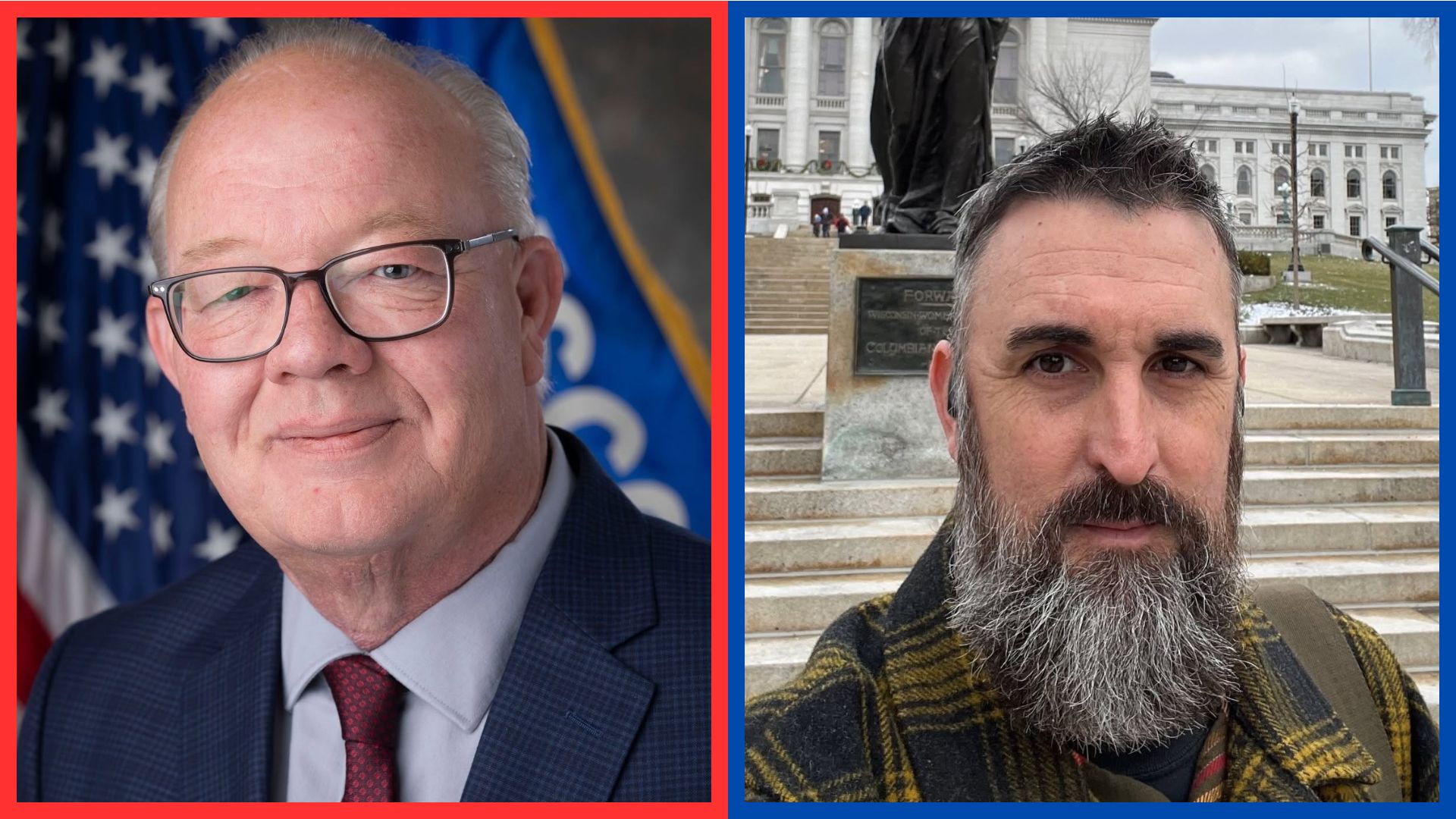
Republican state Rep. Todd Novak is facing game warden Ben Gruber. Both have received more than $1 million from their parties through a loophole the Legislature could close. That cash translates to lots of advertising on TV and in mailboxes.
By Annie Pulley, THE BADGER PROJECT
A Republican incumbent and former newspaper man is facing off against a game warden for control of a state Assembly district that hasn’t been held by a Democrat since 2010.
State Rep. Todd Novak (R-Dodgeville) has represented the 51st Assembly District in southwestern Wisconsin, which includes Mineral Point, since 2015.
Raised on a family farm in little Cobb, Wisconsin, Novak, now 61, says he worked in accounting before he covered government for 25 years at the Dodgeville Chronicle newspaper, rising to an editor position. He served as the mayor of Dodgeville for 12 years before he was elected to the Wisconsin Assembly in 2014.
Ben Gruber, 43, who lives in Arena, Wisconsin, is the Democratic challenger.
Gruber says he has worked as a volunteer EMT, paramedic, firefighter and police officer. He now works for the Wisconsin Department of Natural Resources as a game warden and spends his time “stopping polluters, catching poachers, and rescuing injured hikers from the bluffs of Devils Lake,” according to his campaign website.

Nathan Tataje is also running for the seat as the American Solidarity Party’s candidate. The party was formed in 2016 and is based in the Christian tradition and “the primacy of religion in each person’s life,” according to its website.
In the 99-seat Wisconsin Assembly, Republicans currently outnumber Democrats 54 to 45. Democrats will need a net gain of five seats to take control of the chamber for the first time since 2010.
In his closest election in years, Novak won by three points in November 2024. It was his first time running for reelection in the more competitive district maps that had been signed into law earlier that same year.
A rash of retirements and strong dissatisfaction with the GOP statewide and nationally has Democrats feeling better about their chance at winning back the state Legislature for the first time since 2010.
Who’s paying for all those ads?
Gruber, the Democratic challenger in this race, is winning the money battle, thanks mainly to the Democratic Party of Wisconsin.
The Democratic Party has given Gruber about $1.4 million between January and mid-October, according to campaign finance reports filed with the Wisconsin Ethics Commission. His campaign has raised another $240,000 from individuals and political action committees.
The state GOP has given Novak about $1.2 million in the same time period. Additional donations from individuals and political action committees total more than $100,000.
Tataje has reported raising $675 from four individuals.
Candidates can continue raising funds, and the parties can buy more ads on their behalf, through the election.
State legislators will receive a salary of $64,023 in the 2027-2028 session.
SUPPORT OUR WORK AND HELP US INVESTIGATE THE POWERFUL!
DONATEIn Wisconsin, individual people and political action committees are only allowed to give candidates for the state Assembly a maximum of $1,000 per election cycle.
Donors who have given Novak that maximum include billionaire and conservative megadonor Diane Hendricks, the co-founder of ABC Supply, several groups representing the interests of realtors, alcohol distributors and taverns, and the political action committee for Koch Industries.
Gruber’s received the maximum from Climate Cabinet PAC, which supports pro-climate candidates, Lynde Uihlein, a frequent Democratic megadonor in Wisconsin and cousin of the GOP megadonor Richard Uihlein, and several PACs representing organized labor.
But most of the campaign cash in this race has come from the parties, as Wisconsin does not currently limit what political parties can raise and spend. State Democrats in the minority have proposed adding caps to parties, but the Republican-controlled state Legislature has ignored those attempts.

That loophole in state campaign finance law has led to the flooding of little legislative races like this one with more cash to buy more ads flashed on screens and stuffed in mailboxes than they’ve ever seen.
That’s mostly thanks to a trio of conservative billionaire megadonors who regularly give piles of cash to the state’s GOP. They are giving more this year than ever before, some of which is then routed to races like this one.
So far this year, conservative billionaire megadonor Elizabeth Uihlein has given the Wisconsin Republican Party nearly $25 million, while her husband Richard Uihlein has given the party nearly $16 million. Hendricks, the richest self-made woman in the world, according to Forbes, has given the party about $20 million in the same time period.
By comparison, the top donors to the state Democratic Party so far this year are Sarah O’Neill, the daughter-in-law of deceased billionaire investor Charlie Munger, who has given $4.3 million and Lynde Uihlein, who has given about $2.3 million to the Democratic Party of Wisconsin.
The issues
The candidates have all made funding public schools a focus of their campaigns.
Novak has touted his support for the last state budget that increased per-pupil spending by $604.
Gruber’s campaign website says he’s seen how “state neglect” has disrupted schools and rural communities. He says he will “fight for fair school funding.”
Tataje says on his website that he’ll support permanent property tax relief through a rural school endowment, funded by the state’s current surplus.
Gruber said he is also eyeing the rising costs for families, including housing and healthcare.
“Every day when I knock on doors across the district I hear from folks who are struggling to make ends meet or I hear concerns about how our communities are starved for resources. My opponent is funded by three billionaires and special interests who are making our lives more expensive,” Gruber wrote in an emailed statement to The Badger Project. “When I’m in the Assembly, I’ll work for our neighbors and communities, not billionaires.”
Novak’s campaign did not respond to requests for comment, but his website points to his work in the state Legislature to lower insurance premiums, ensure those with preexisting conditions receive coverage, and his vote to support new mothers with postpartum healthcare.
Wisconsin Conservation Voters, an advocacy group that pushes for environmental causes, rated Novak’s “lifetime” score at 37%. Gruber received the group’s endorsement in August.
Novak’s campaign website notes his work to oppose mining and support Wisconsin’s wetlands.
Tataje says he will steward natural resources and prioritize local property values above constructing hyperscale data centers.
Wisconsin Manufactures and Commerce, the state’s Chamber of Commerce, has given Novak, and many other Republican legislators, the “Working for Wisconsin” award, based on their pro-business efforts during the recent Legislative Session.
Novak has also championed a bill to protect people and news organizations from meritless lawsuits seeking to punish them for their speech. Wisconsin is one of the only states without such a law.
Novak’s bill would have allowed defendants to get quick dismissals against these lawsuits, called Strategic Lawsuits Against Public Participation, or SLAAPs, rather than have to wage an expensive fight in court. In states without anti-SLAAP laws, wealthy individuals have kept individuals who said or wrote things they don’t like fighting endless motions in court to try and stick them with huge legal bills and even bankrupt them. The Wausau Pilot news organization had to spend nearly $200,000 fighting a SLAPP lawsuit it eventually defeated.
The bill got close to passage but ultimately died in the state Senate in March.
This story was funded by a grant from the Mount Horeb Community Foundation.
The Badger Project is an independent news nonprofit in Wisconsin.
FREE TO READ. EXPENSIVE TO PRODUCE.
Creating our hard-hitting news takes a lot of time and money.
A story like this needs at least 8 hours to research, write and edit.
Please consider financially supporting The Badger Project to help us do more reporting in the future.


Leave a Reply