

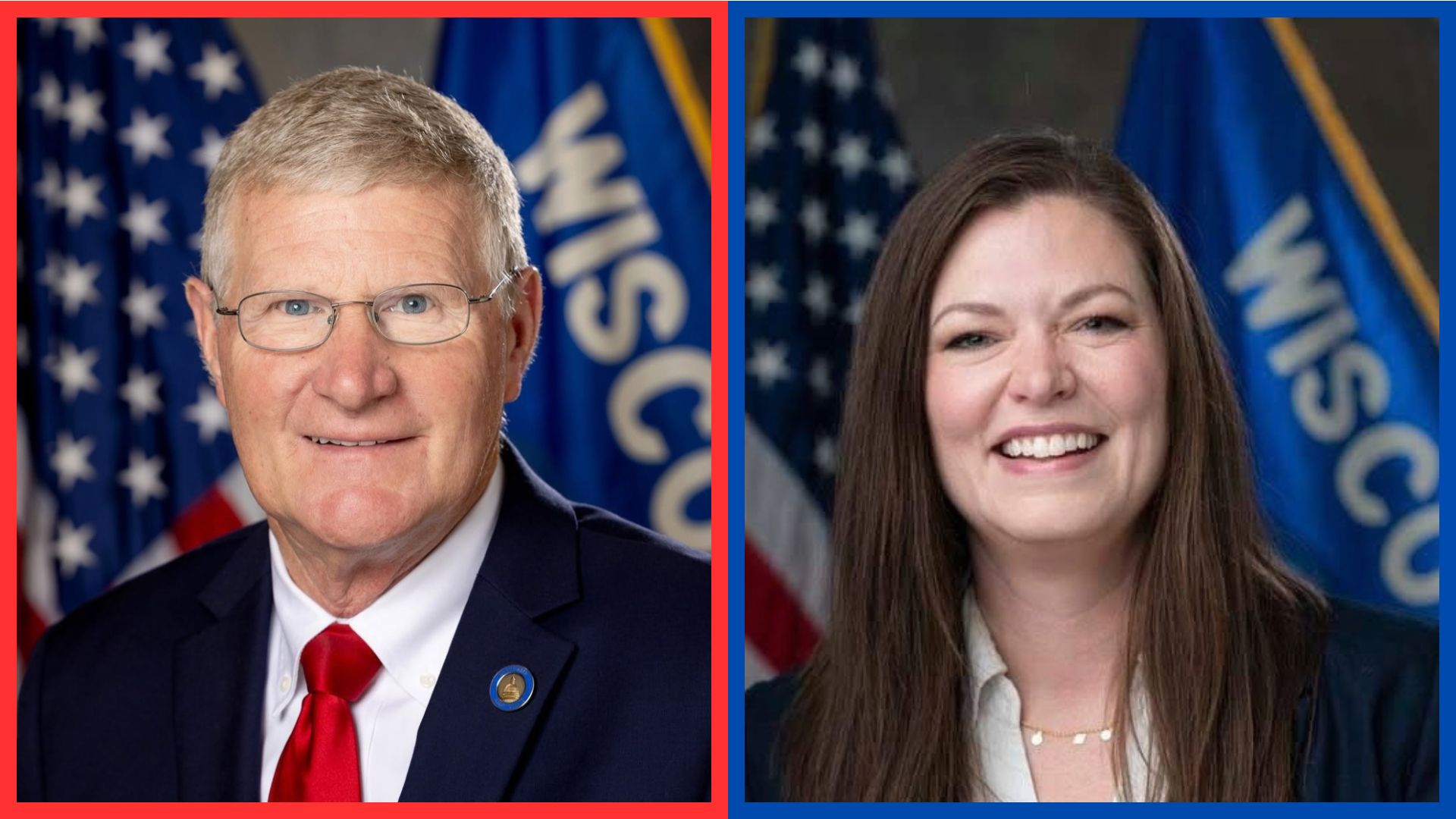
Both parties are using a well-worn loophole to boost their candidate with extraordinary sums, leading to a tsunami of political advertising for the relatively little race.
Annie Pulley, THE BADGER PROJECT
Both parties are bankrolling a costly fight for a swing district that’s been represented by Republican state Sen. Howard Marklein for more than a decade.
Marklein, the 72-year-old incumbent who grew up on a dairy farm in Spring Green, is facing off against state Rep. Jenna Jacobson of Oregon, a 44-year-old Democrat. He’s received about $500,000 more than Jacobson, according to campaign finance reports filed with the Wisconsin Ethics Commission between January and October.
The Democratic Party of Wisconsin gave Jacobson about $1.5 million from January through the most recent reporting window that ended Oct. 26, most of which has gone to purchasing TV ads and mailers. She has also raised about $350,000 from individuals and political action committees.
In the same time, the Republican Party of Wisconsin gave Marklein about $2 million, according to reports filed with the state. Individuals and political action committees have given him about $430,000.
By comparison, state legislators will receive a salary of $64,023 in the 2027-2028 session.
Campaigns can continue fundraising through the election.
A retired accountant, Marklein won a seat in the state Assembly in 2010 before moving to the state Senate in 2014.
Jacobson previously worked as a housing program specialist and financial analyst, according to her legislative bio. She also sat on Oregon’s village board.
Both candidates are benefiting from a glaring campaign finance loophole; in Wisconsin, political parties can raise unlimited amounts of money and donate unlimited amounts to candidates.
A U.S. Supreme Court decision created the loophole back in 2014. Wisconsin’s Republican-controlled legislature has opted not to close it, ignoring attempts by Democratic legislators in the minority to do so.
Both parties have taken full advantage, accepting millions from their billionaire supporters before funneling piles of cash to candidates and circumventing limits on individuals who donate to campaigns directly. Until 2026, megadonors to the state Democratic Party had dominated political giving in recent years.
Consider a donation to help us shine a light on the powerful in Wisconsin.
DONATEState law caps donations from individuals and political action committees to candidates for the Wisconsin State Senate at $2,000 per election cycle.
Marklein has received the maximum contribution from dozens of individuals and groups, including conservative megadonor and billionaire Diane Hendricks, several groups representing realtors and the political action committees for Charter Communications, Koch Industries and Northwestern Mutual Insurance. Hendricks has also given nearly $20 million to the state GOP this year, some of which may have made its way to Marklein’s campaign.
Jacobson’s top individual contributors include environmental and labor groups as well as EMILYs List, a political action committee that supports pro-choice female candidates.
The total contributions reported by both candidates don’t include money spent by outside groups like super PACs, which can run advertising to support or oppose candidates. These groups are not limited in how much they can raise and spend, but by law cannot coordinate directly with any candidate’s campaign.
The state Senate is currently controlled by Republicans, 18 to 15. To gain a majority, Democrats need a net gain of two seats. Republicans have controlled the Wisconsin State Senate since 2011.
The district borders of the state Legislature changed in 2024 after Republicans approved maps submitted to the courts by Gov. Tony Evers, a Democrat. Previously, Republican legislators like Marklein had been able to run in more favorable maps drawn by their own political party. November’s election will be the first time Marklein faces a challenge using the new, more competitive maps.


These maps make Democratic victories more likely, said Anthony Chergosky, a political science professor at UW-La Crosse.
The race between Marklein and Jacobson is one of four high-profile state senate contests, Chergosky noted. Of those, it’s the only one where a Republican incumbent is running for reelection.

“Defeating an incumbent is a much different type of challenge than winning an open seat,” Chergosky wrote in an email to The Badger Project. “Jacobson’s spending advantage can help her introduce herself across the larger Senate district. Meanwhile, Marklein can point to his powerful position as co-chair of the Joint Finance Committee to make the case that his influence in the legislature benefits the district.”
Democrats don’t need the seat to flip the state Senate, Chergosky said. They just need to hold their 15 seats and pick up those being vacated by two retiring Republican state senators in swing districts.
In those, the GOP is contributing more to their candidates than the Democratic Party has so far.
Marklein’s district encompasses the southwestern corner of the state, including Crawford, Grant, Green, Lafayette and Iowa counties as well as the southwestern portion of Dane County. He’s represented the district since 2014.
Jacobson has represented Assembly District 50 since 2022. Her district makes up the eastern third of Marklein’s Senate district.
State senators serve four-year terms. The salary for a state legislator in 2027 will be about $64,000 a year.
Issues
Marklein and Jacobson have both made education, affordable healthcare and the cost of living primary components of their campaigns.
“Howard has been in the Senate for the last decade and in that time we have lost schools, hospitals, family farms, and watched as families are priced out of their communities,” wrote Jacobson’s campaign manager Orion Danou in an email to The Badger Project. “He has consistently put working Wisconsin families on the chopping block to appease his Epstein-class donors. Jenna Jacobson has shown she is working for Wisconsinites.”
Marklein’s campaign did not respond to multiple requests for comment.
Jacobson believes the state Legislature ought to prioritize public school funding, including for special education and school safety, according to her campaign.
Marklein calls himself a “strong supporter of public K-12 education” and argues he has “used (his) position on the Joint Committee on Finance to ensure each student has the opportunity to succeed,” he states on his campaign website.
The senator said in a Facebook post that he’s helped secure funding for hospitals, mental health services and long-term care through his work on the state budget, which Jacobson voted against, along with most legislative Democrats, before Evers signed it. Marklein said he plans to double down on these investments and to expand telehealth for rural families.
Jacobson said she plans to continue her work to expand postpartum Medicaid coverage, lower the cost of prescription drugs and advocate for women’s reproductive health. The state representative announced she was endorsed by Planned Parenthood in September.
Marklein touted the tax cuts in the last state budget and said he hopes to legislate in a way that makes it easier and faster to build housing.
Jacobson also said she wants to increase the housing supply and argues the state’s minimum wage, sitting at $7.25, must be increased. Iowa’s minimum wage mirrors Wisconsin’s, but Minnesota’s minimum wage is about $11 and Illinois’ is $15.
The Freedom Index, a group that ranks members of Congress and state legislators for their records on issues like limited government, fiscal responsibility and national and state sovereignty, gave both Marklein and Jacobson an F, although Marklein scored 57% and Jacobson 8%.
Wisconsin Conservation Voters, an organization that advocates for pro-environmental candidates, included Jacobson among its list of dozens of legislators named a “Conservation Champion.”
Its scorecard also singled out those lawmakers, including Marklein, who “go to extraordinary lengths to jeopardize Wisconsin’s natural resources and democracy, simply to hold onto power.”
The report wrote that Marklein, along with another state legislator, spearheaded a bill meant to stifle the state’s clean energy progress by requiring local approval for certain wind and solar projects in addition to approval from the Public Service Commission.
Wisconsin Family Action, an advocacy group that describes itself as defending marriage, family, life and religious freedom, reported that Marklein voted in agreement with the group’s position on bills 86% of the time on its most recent scorecard, whereas Jacobson voted in alignment with the group’s positions 33% of the time.
Voters in Senate District 17 head to the polls to choose between the two candidates Nov. 3.
| Donors who gave the max to Marklein | City & State | Donors who gave the max to Jacobson | City & State |
|---|---|---|---|
| Daniel Jansen | Dikeyville | Adam Jermyn | Sanford, N.C. |
| Adam Beren | Wichita, Kan. | Anne Connor | Ridgeway |
| Brian Dillman | Prairie Du Chien | Ari Weinstein | San Francisco, Calif. |
| Charter Communications, Inc. | Madison | Barbara Stuart | Edmonds, Wash. |
| Concerned Realtors Committee | Wauwatosa | Barry Boothe | San Francisco, Calif. |
| Edwin Gardinier | Milton | Catherine Grundmann | San Mateo, Calif. |
| Feyen for Senate | Fond du Lac | Charles Bullock | Hillsborough, Calif. |
| Friend of Eric Wimberger | Green Bay | Climate Cabinet PAC | San Francisco, Calif. |
| Cory Berg | Dodgeville | Donald Etzbach | San Mateo, Calif. |
| Dan Hartung | Madison | EMILYs List-NF Fund | D.C. |
| Daniel Gavinski | Wisconsin Dells | Friends of Tim Carpenter | Milwaukee |
| Darrin Stanton | Livingston | International Union of Painters and Allied Trades Political Action Together Political Committee | Hanover, Md. |
| Diane Hendricks | Afton | Jane Katz | Missoula, Mont. |
| Don Millis | Sun Prairie | Joan Jones | Fort Atkinson |
| Donald Wahlin | Stoughton | Joanne Witty | Bedford Hills, N.Y. |
| Friend of Julian Bradley | New Berlin | Justine Haselow | Edina, Minn. |
| Friends of Mary | Madison | Keyeski for Wisconsin | Lodi |
| Friends of Rachel Cabral-Guevara | Appleton | Kristen Sandifer | Hillsborough, Calif. |
| Heather Huschitt | Monroe | Linus Upson | Woodside, Calif. |
| Ilene Patterson | Monroe | Local 400 COPE Fund | Kaukauna |
| Jeffrey Falk | Monroe | Marc Katz | Missoula, Mont. |
| Jill Diehl | Lake Delton | Mark Ediger | Madison |
| John Scott | Wisconsin Dells | Matthew Bernstein | Atlanta, Ga. |
| Julie Caldwell | Whitewater | Max Lagally | Madison |
| Karl Schmidt | Green Bay | Michael & Janet Brandt | Spring Green |
| Kevin Mehring | Madison | Brennan for Wisconsin | Milwaukee |
| Kimberly Knudsen | Whitewater | Natalie Bernstein | Atlanta, Ga. |
| KochPAC | Wichita, Kan. | Plumbers Local 75 PAC | Milwaukee |
| Lou Schweigert | Cuba City | Richard Samson | Mequon |
| Margaret Diehl | Wisconsin Dells | Robert Haselow | Edina, Minn. |
| Margaret Scott | Wisconsin Dells | Ross Boucher | San Francisco, Calif. |
| Mark Finnegan | Beloit | Service Employees International Union Wisconsin State Council PAC | Madison |
| Matt Neumann | Hartland | Teresa Welch | Corvallis, Ore. |
| Molly Wiegel | Darlington | Theodore Spencer | New York, N.Y. |
| Northwestern Wisconsin REALTORS PAC | Eau Claire | Thomas Rothman | Los Angeles, Calif. |
| Pamela Christen | Edgerton | Tina Cole | San Carlos, Calif. |
| Patrick English | Wauwatosa | Todd Vogel | Seattle, Wash. |
| REALTORS Association of South Central Wisconsin PAC | Madison | UAW Wisconsin State PAC | Ottawa, Ill. |
| Robert Arzbaecher | Naples, Fla. | WEAC PAC | Madison |
| Robert Trone | Potomac, Md. | Wisconsin Laborers District Council | DeForest |
| Sarah Knutson | Beloit | Wisconsin PEOPLE Conference | Madison |
| Scott Frank | Cottage Grove | Wisconsin Carpenters PAC | Madison |
| Stella Scott | Wisconsin Dells | Zoe Aron | Los Angeles, Calif. |
| Stephanie Medley | Green Bay | This is the PAC | Madison |
| Steven Stettler | Monroe | — | |
| Taxpayers for John Jagler | Watertown | — | |
| Tenley Scott | Wisconsin Dells | — | |
| Testin for Senate | Stevens Point | — | |
| Theresa Scott | Wisconsin Dells | — | |
| Therese Nichols | Elm Grove | — | |
| Thomas Lucke | Wisconsin Dells | — | |
| Thomas Nichols | Elm Grove | — | |
| Todd Nelson | Wisconsin Dells | — | |
| Sara Lesar | Waukesha | — | |
| Zachary Knutson | Beloit | ||
| Benjamin Scott | Wisconsin Dells | — | |
| Glennette Stettler | Monroe | — | |
| James Digangi | Darlington | — | |
| John Scott | Wisconsin Dells | — | |
| Judy Wenger | Madison | — | |
| Katie Digangi | Darlington | — | |
| Northwestern Mutual PAC | Milwaukee | — | |
| Peter Wautlet | Williams Bay | — | |
| Kathryn Burke | Milwaukee | — |
This story was funded by a grant from the Mount Horeb Community Foundation.
The Badger Project is an independent news nonprofit in Wisconsin.
FREE TO READ. EXPENSIVE TO PRODUCE.
Creating our hard-hitting news takes a lot of time and money.
A story like this needs at least 8 hours to research, write and edit.
Please consider financially supporting The Badger Project to help us do more reporting in the future.
Leave a Reply